Details
Redesining Exit Experience
Every month, 65% of users who saw their insurance quote disappeared between price reveal and checkout—representing roughly $18M in lost annual revenue. We had no mechanism to recover these users or understand why they left.
I led this project to design a strategic exit-intent intervention that transformed permanent losses into recoverable leads, increasing saved quotes by 10.8% and creating a $2M revenue recovery opportunity.
Impact
Within just 6 months, increased the rate of saved insurance quotes by up to 10.8%, directly contributing to higher revenue growth.
My role
Lead Designer
Lead Designer
Team
Product owner,
User Research Team,
Business insights,
Development
Timeline
February – April 2024
The challenge
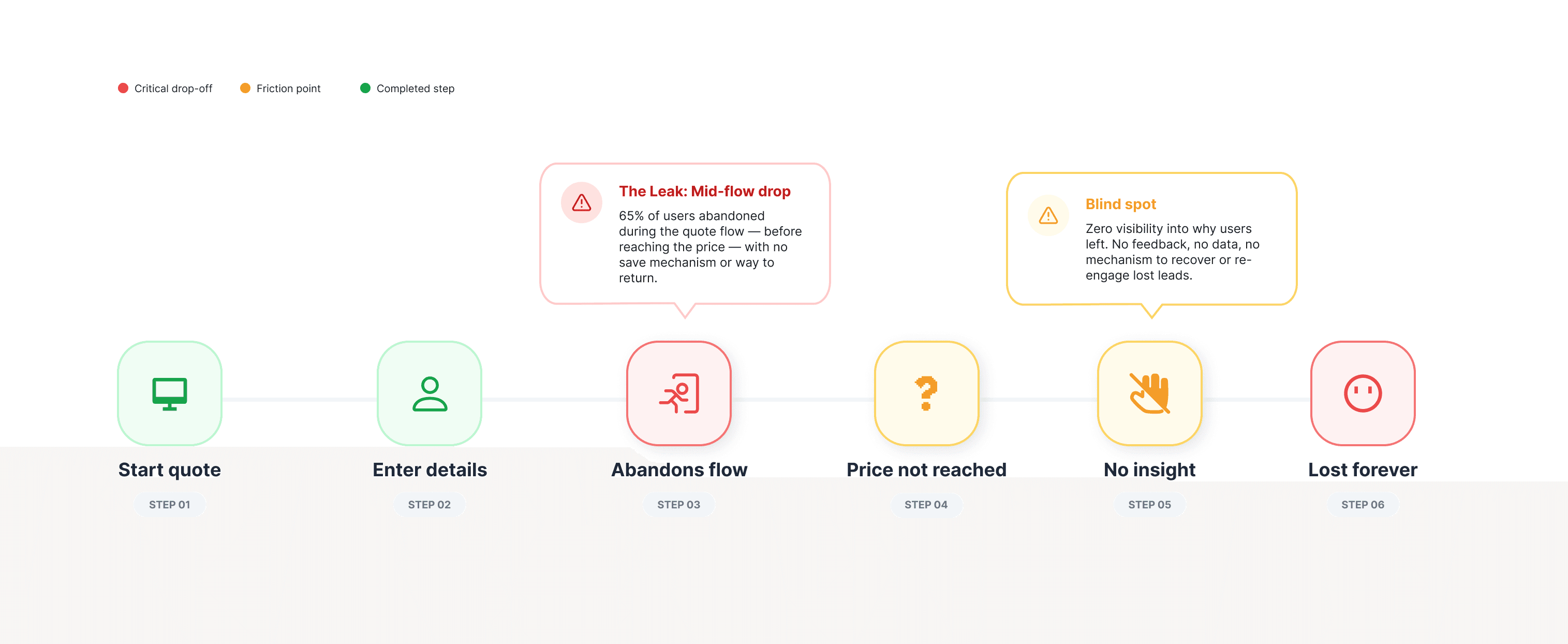
1.1 User painpoints:
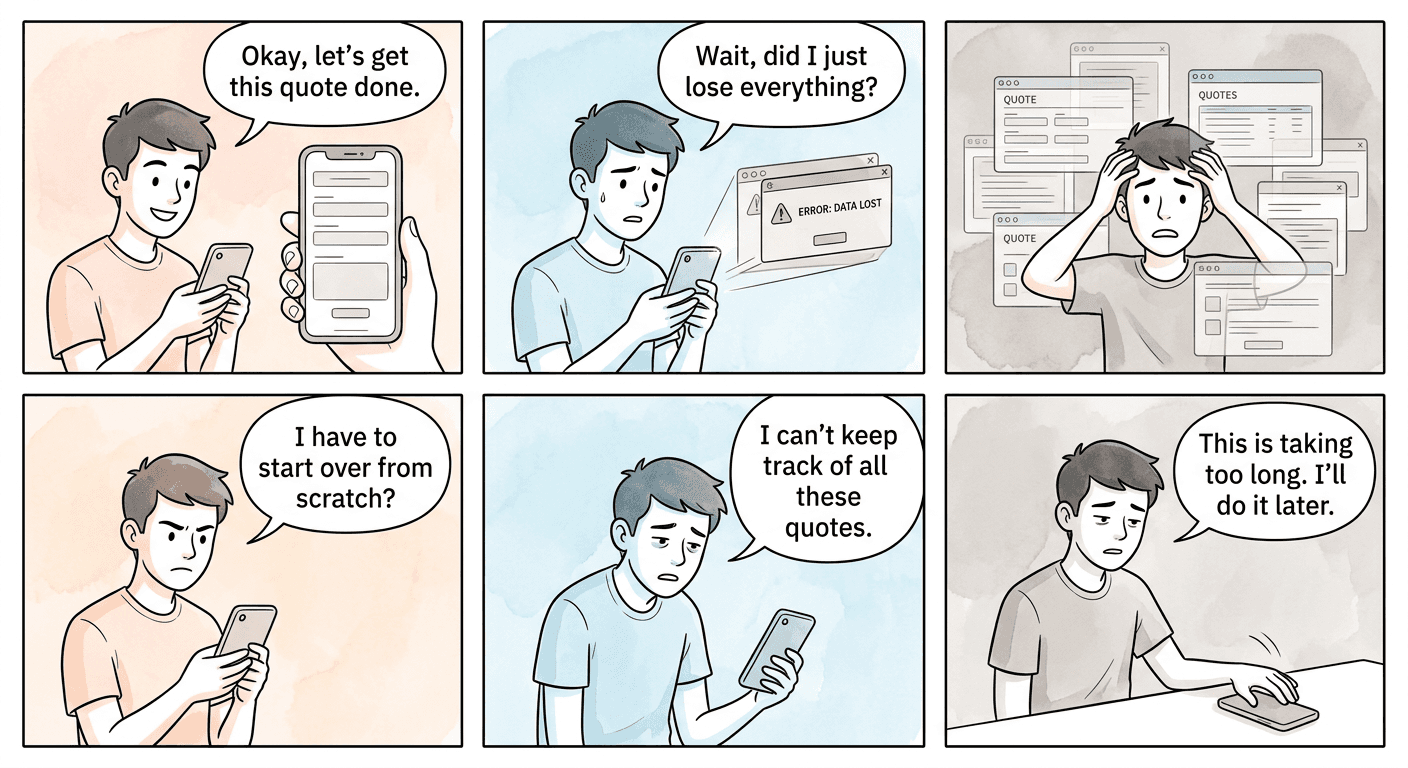
1.2 Business painpoints:
Price-conscious customers were speed-running through checkout, selecting the cheapest option without processing what they were committing to. The low price point was an incentive, but the associated requirements weren't being effectively communicated or absorbed during the quoting process.
This created a "surprise-and-reject" moment post-purchase when app requirements became clear.
discovery & research
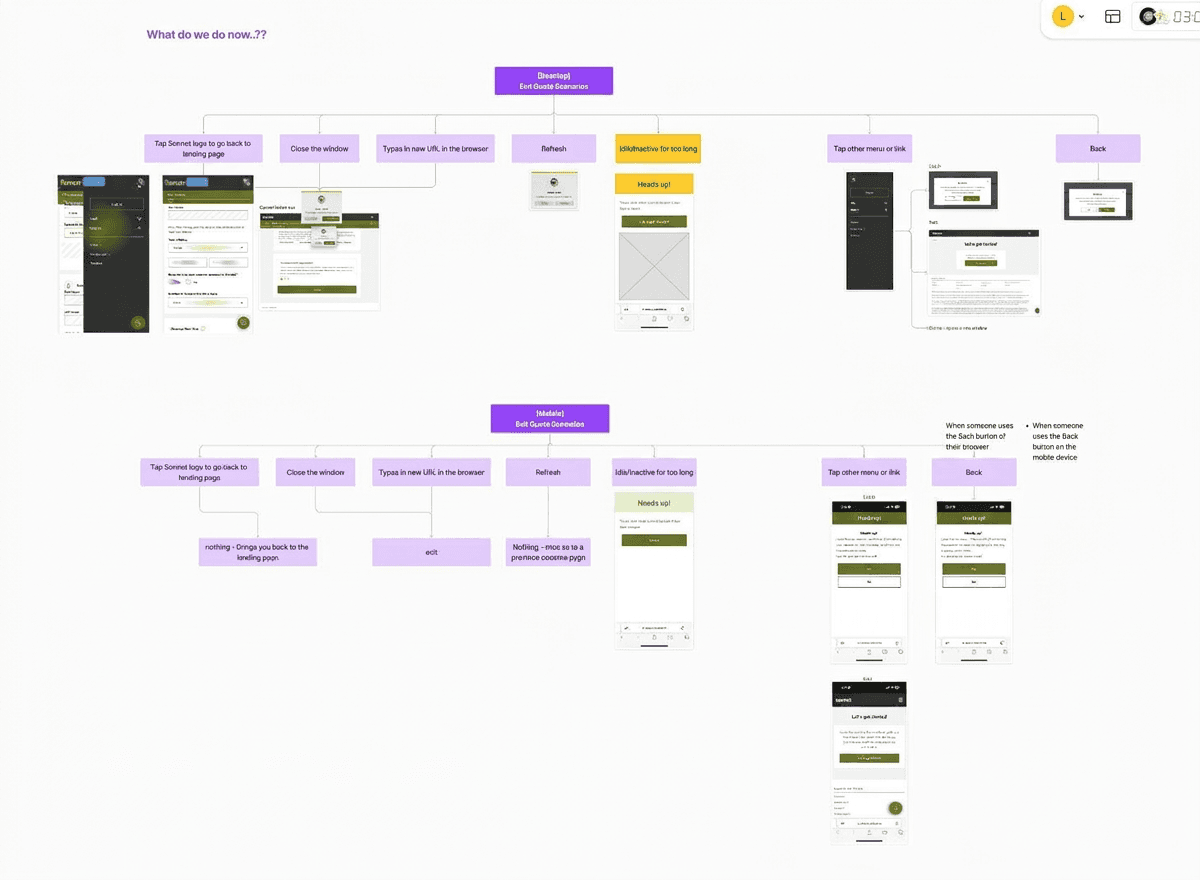
Identifying exit pathways and patterns
Started by mapping every possible exit point across desktop and mobile. The data revealed a consistent story: multiple abandonment scenarios confirmed that most exits resulted in a complete loss of the user's quote progress.
2.1 Investigation:
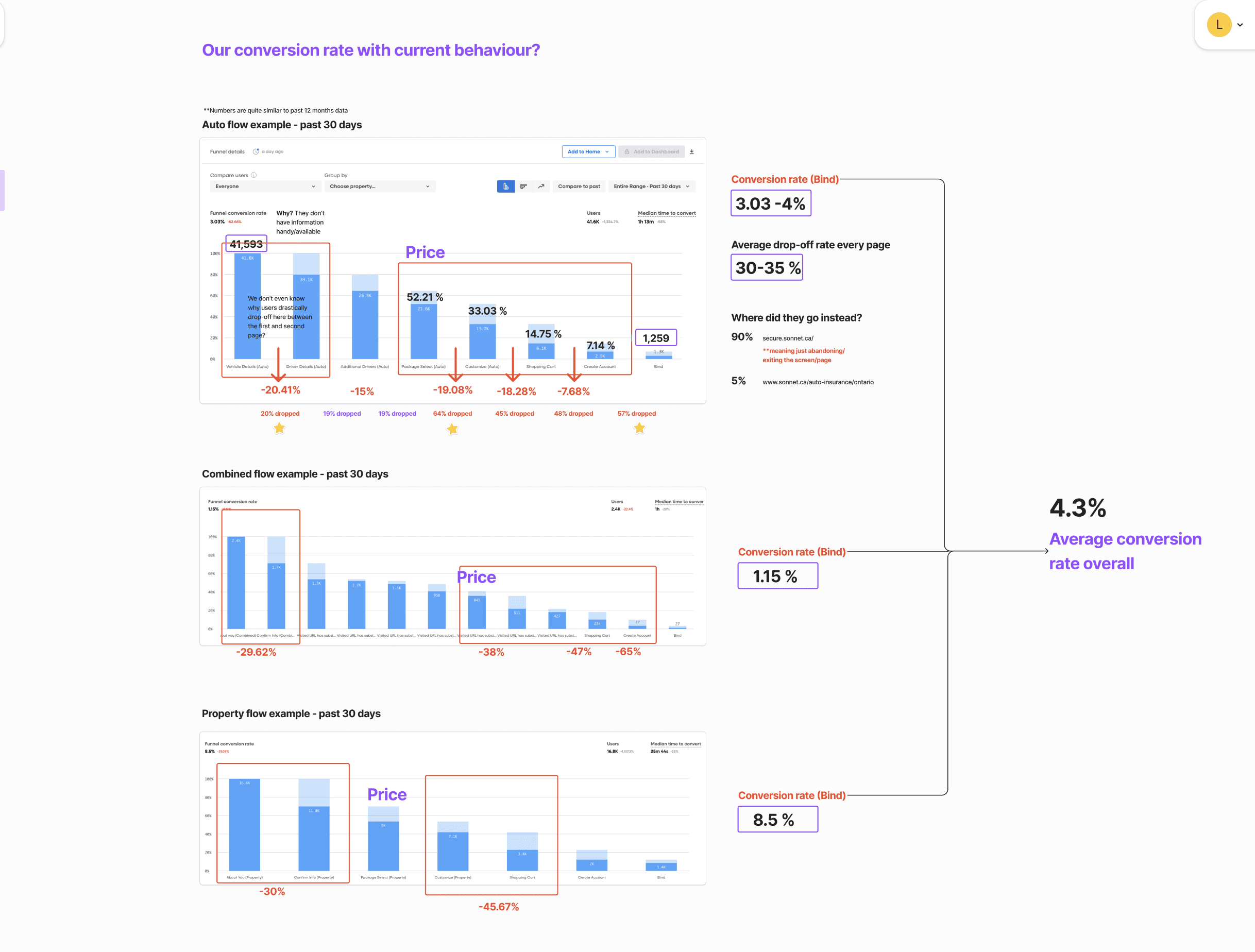
key findings
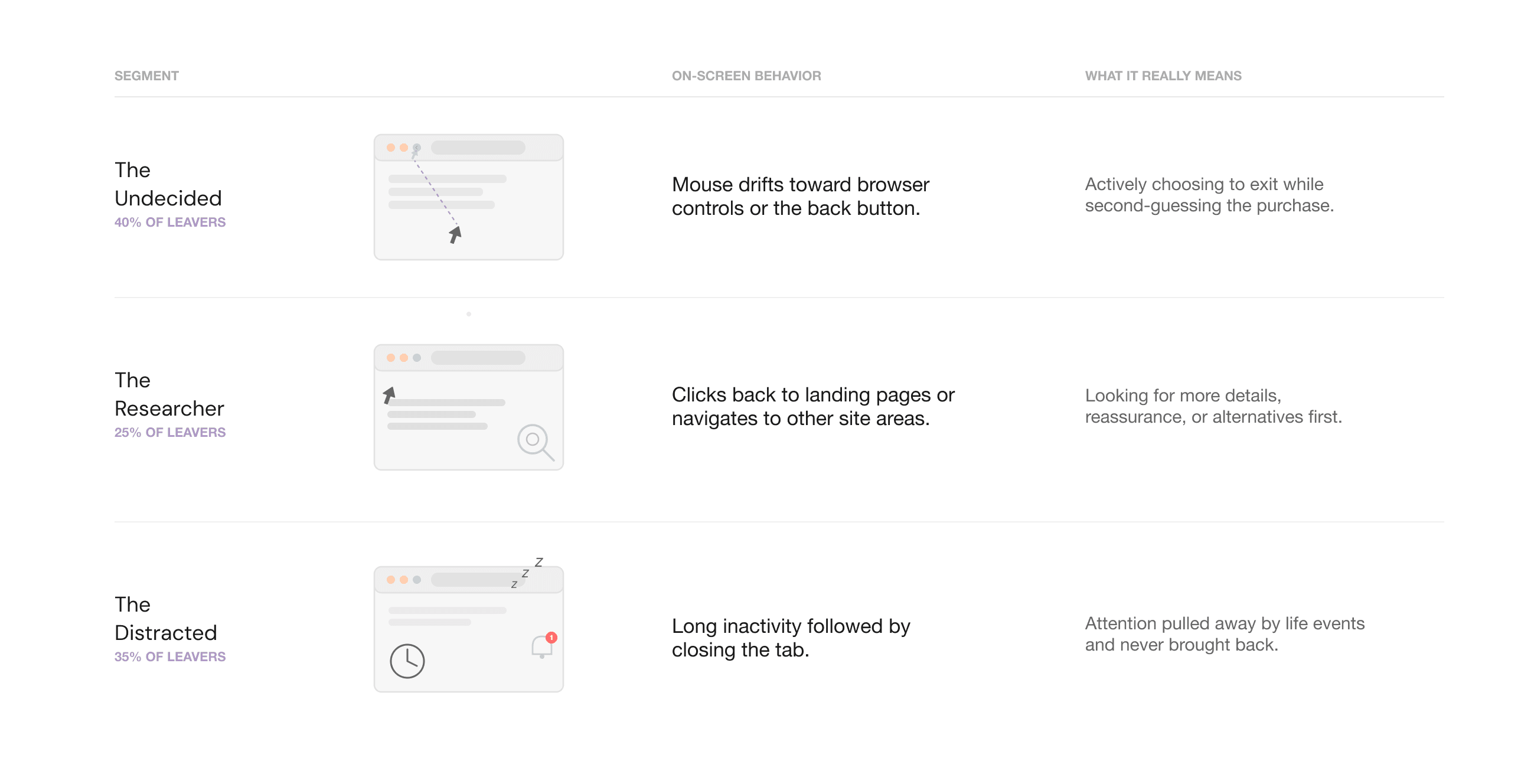
Understanding Exit Behaviours
Analysis of three core exit behaviours reveals the underlying reasons users abandon the quote flow. This insight enables targeted interventions that address specific friction points and user needs.
2.3 Reframing Problem | Design Strategy
Exit-intent technology tracks users behaviour signalling an intent to leave (e.g., mouse movement to close a tab) and displays a timely prompt. We evaluated three primary strategies based on industry data. Rather than forcing immediate completion, I reframed the goal: convert permanent losses into recoverable opportunities. Users might not be ready now, but that doesn't mean they won't be ready later.
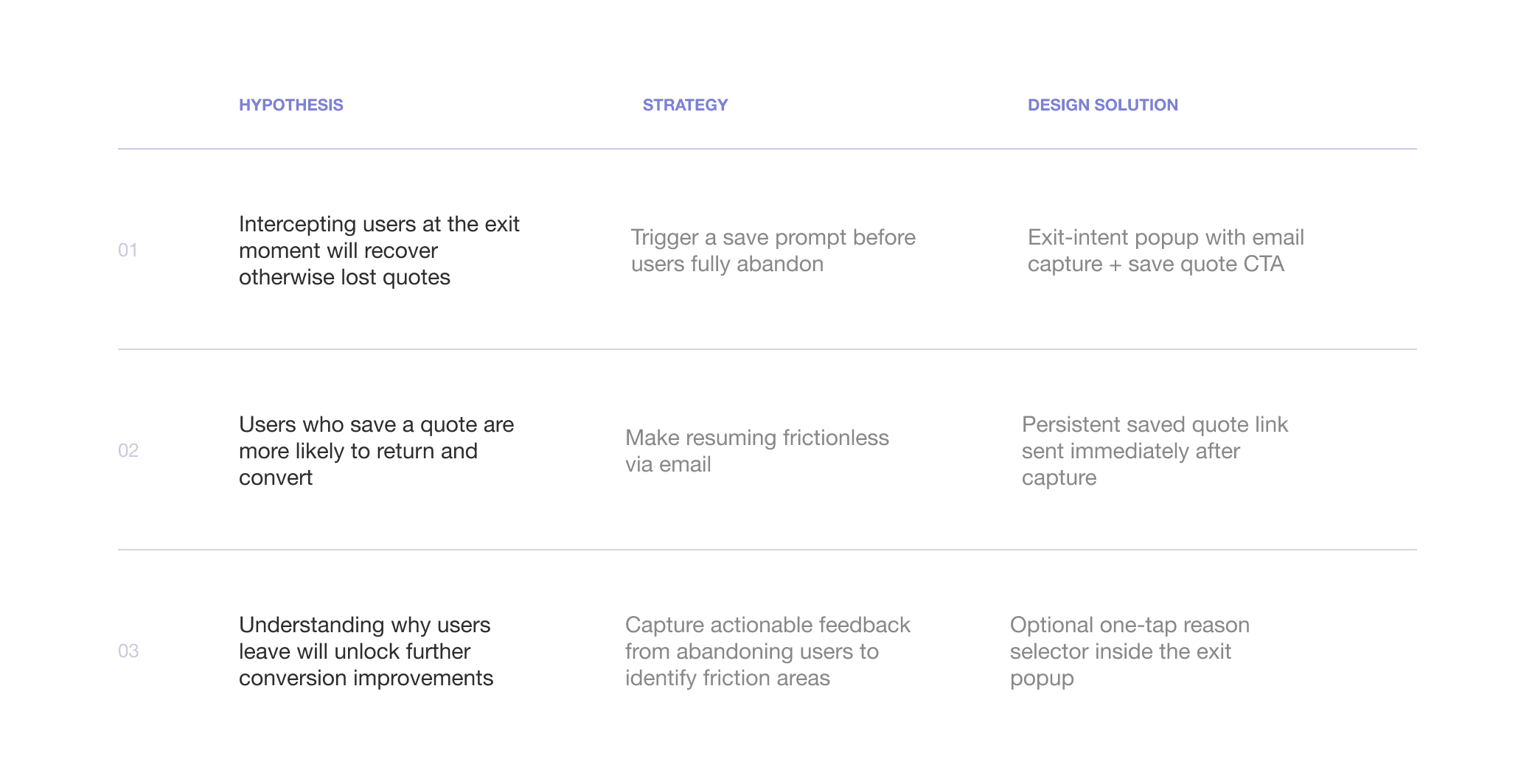
the journey
Proposed journey
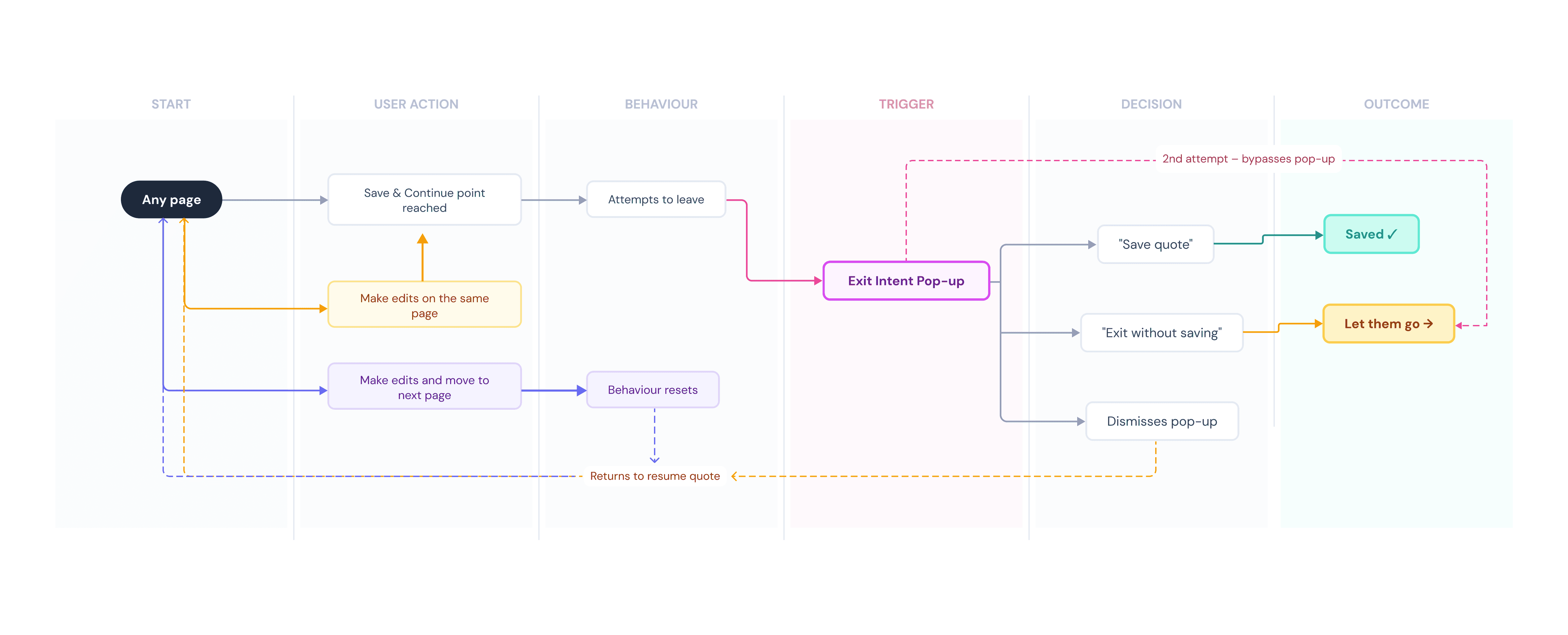
Proposals
3 Proposed solutions | Lo-Fis
Drawing from the design strategy and behavioural analysis, I explored three alternative solutions tailored to each user exit pattern.
Option 1: Survey + Save & Continue
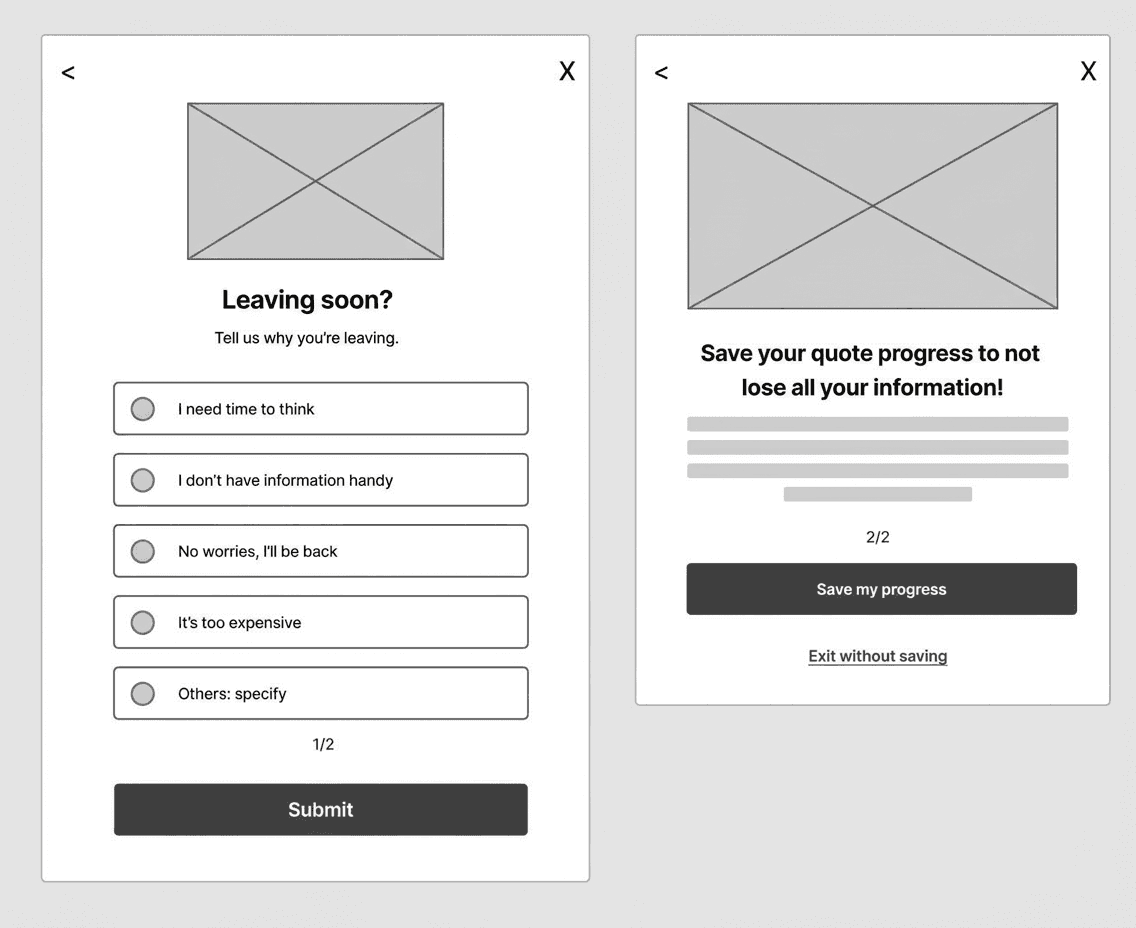
What it does: A dual-purpose pop-up that captures abandonment reasons *and* allows users to save their progress.
Benefit: Gathers actionable feedback for future product improvements while also retaining the user.
Option 2: Save & Continue Only
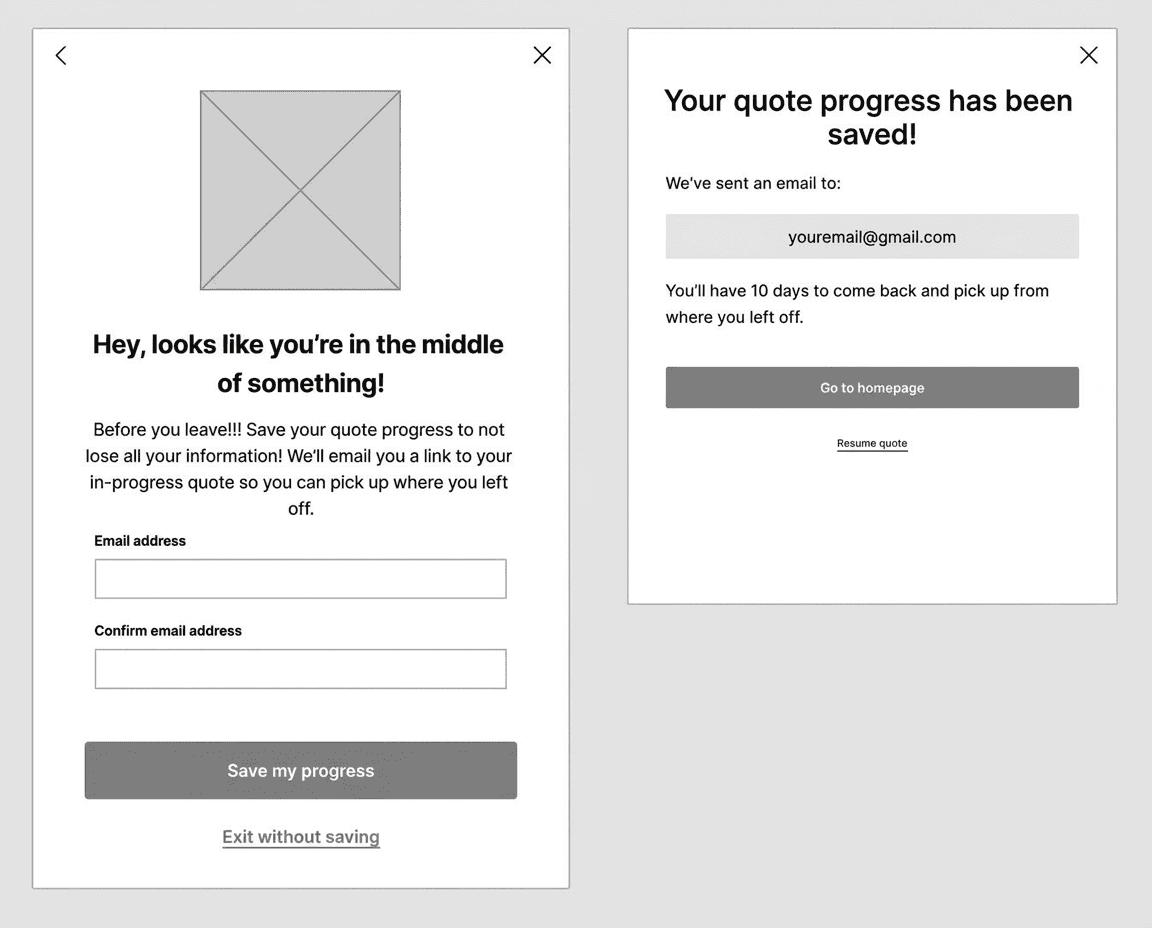
What it does: A focused pop-up triggered when users navigate away to explore (e.g., clicking the logo).
Benefit: Retains users who are still interested but are navigating away for research, preventing accidental progress loss.
Option 3: Idle/Inactive Popup
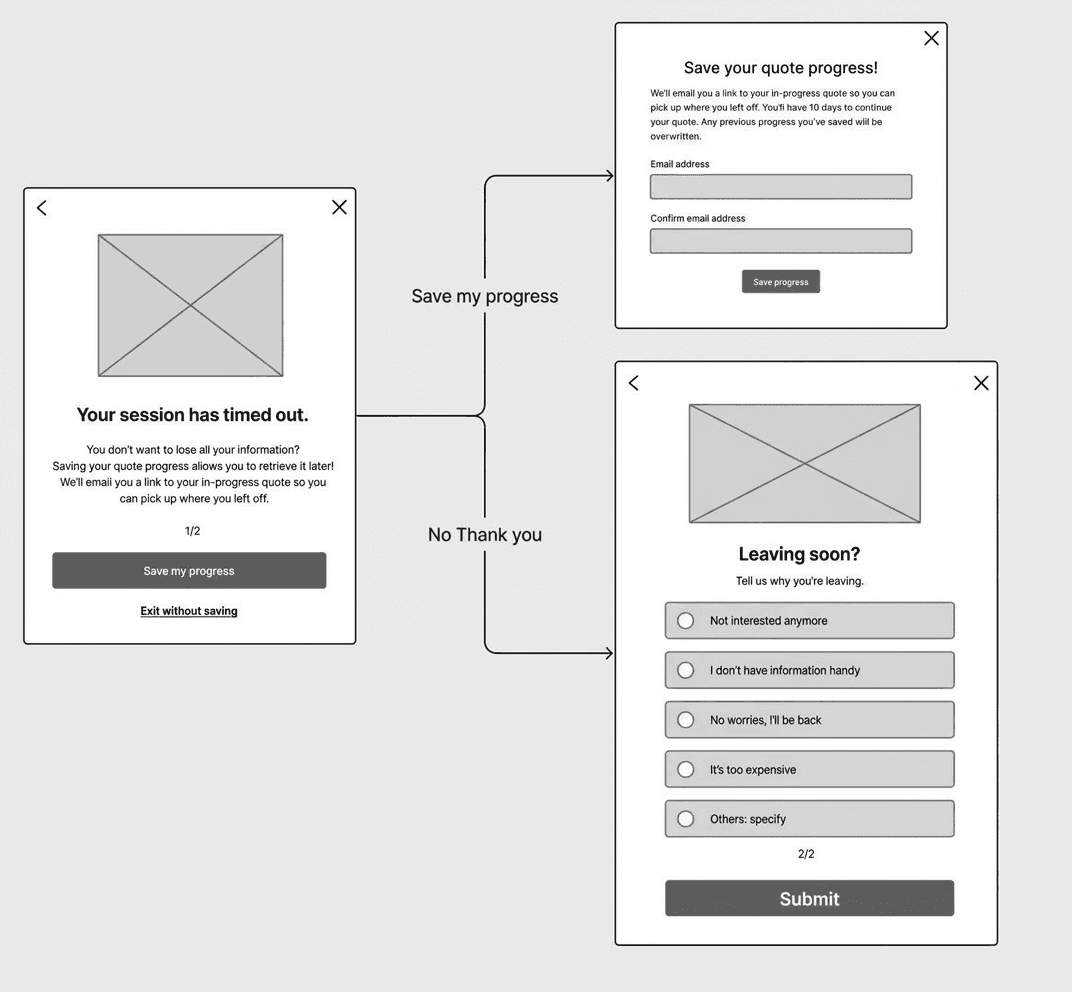
What it does: Prompts users to save progress or provide feedback after a period of inactivity leads to a session timeout.
Benefit: Recovers potentially lost quotes from users who have been interrupted.
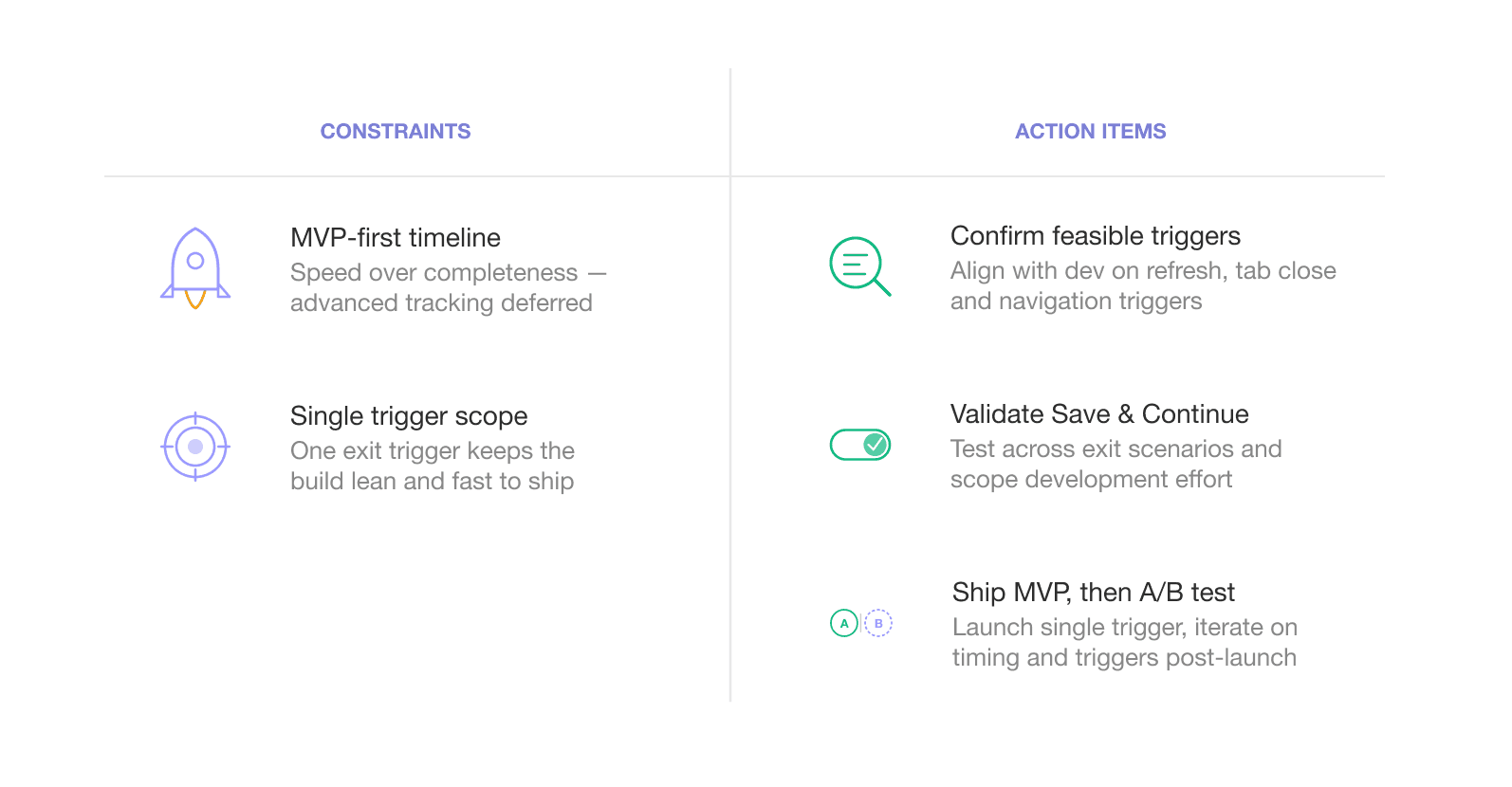
3.1 Understand Constraints & Prioritization
Given leadership's priority for rapid delivery and existing developer bandwidth, we adopted an MVP strategy. This allowed us to deploy a high-impact solution quickly and gather live user data for future iterations.
MVP
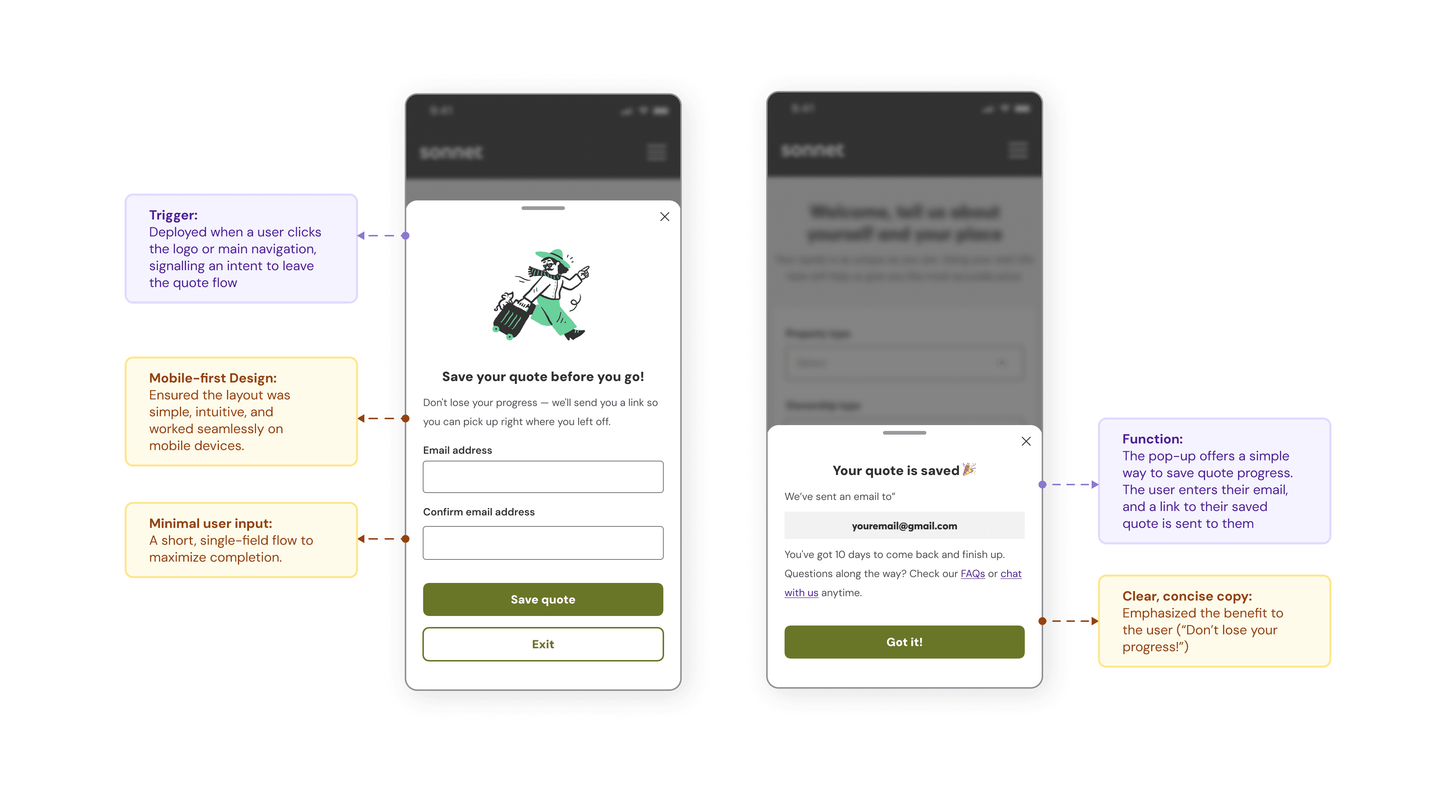
Final MVP Design

Results
The impact
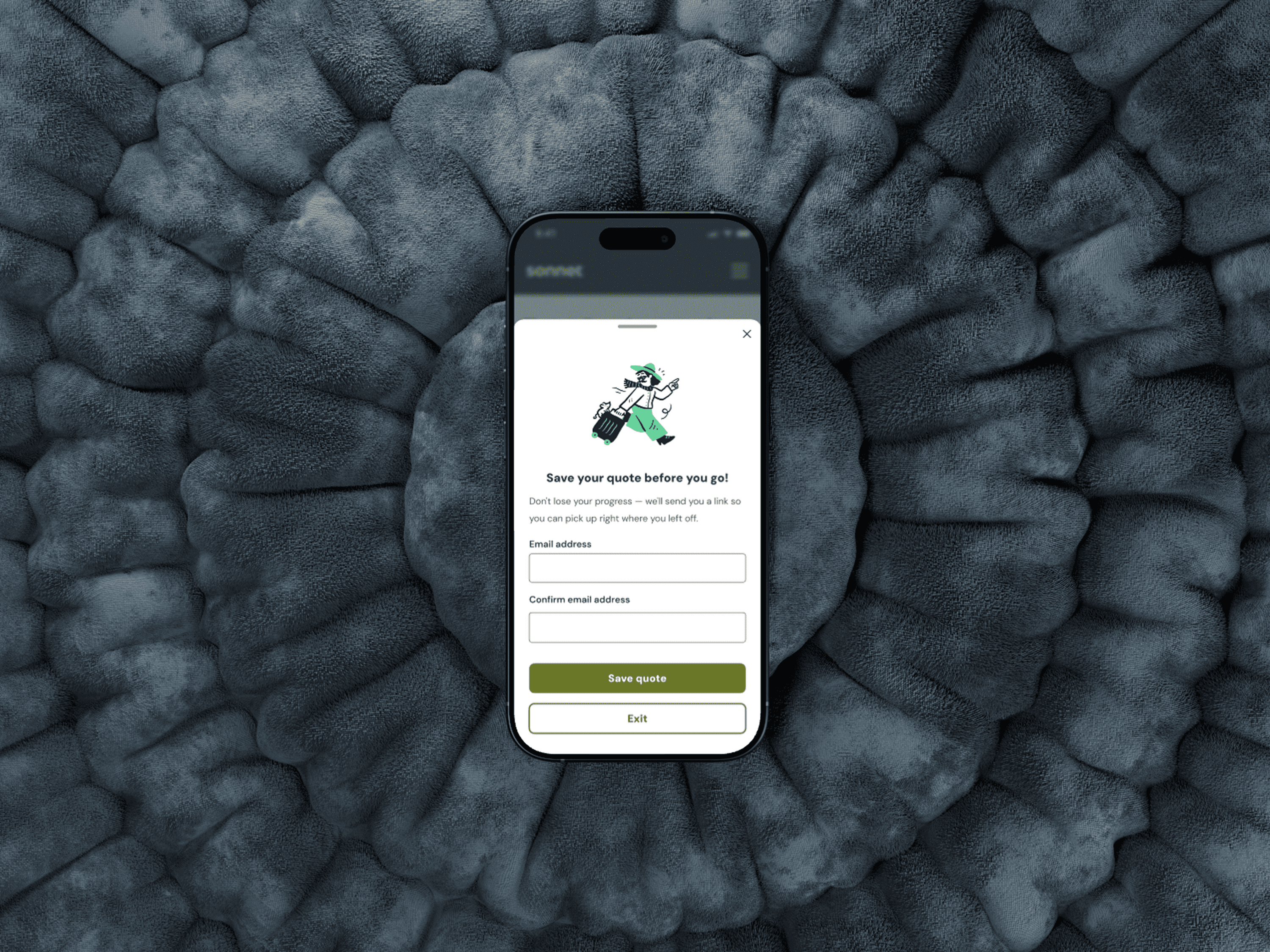
The Save & Continue Exit-Intent feature allows users save their progress mid-flow, and accidental exits trigger a recovery prompt–eliminating the hassle of re-entering information.
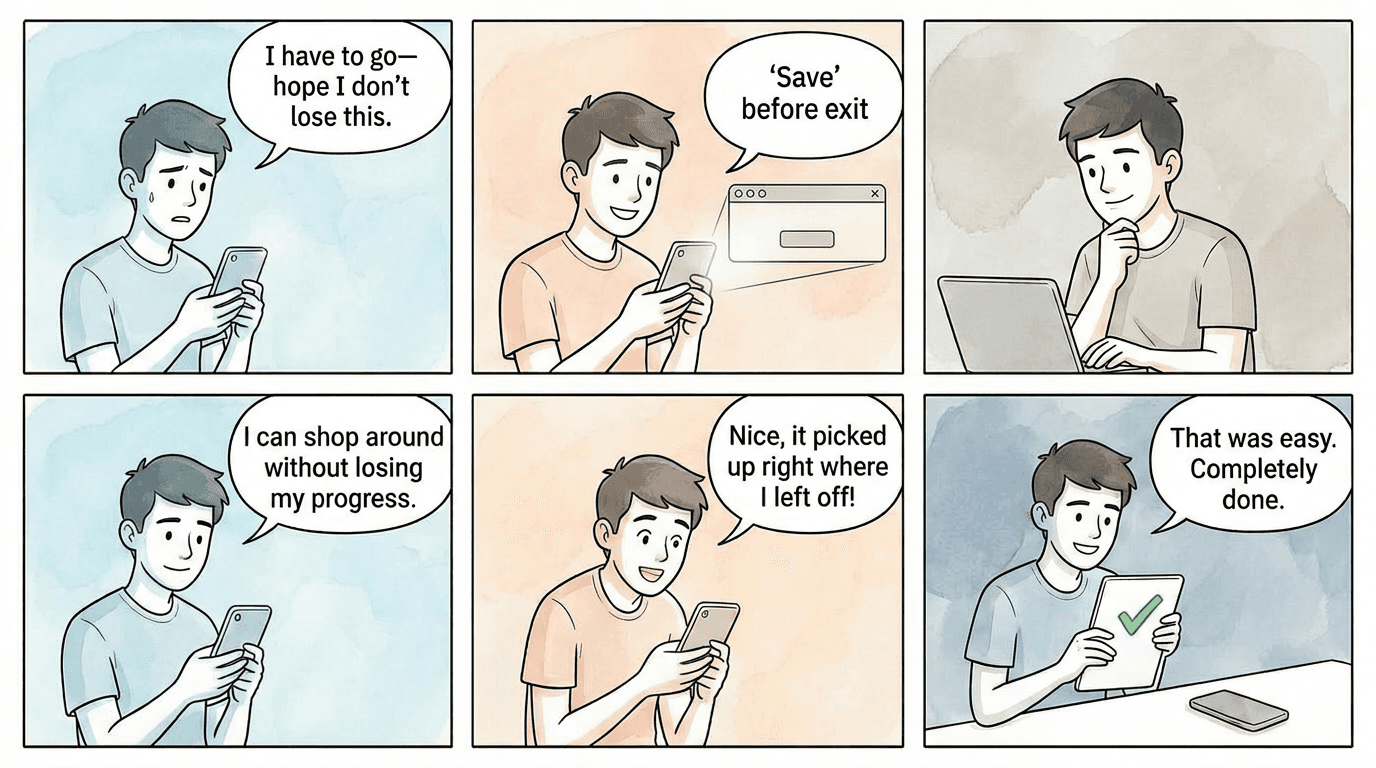
With this feature launch, we successfully reduced quote abandonment by enabling seamless progress preservation and recovery.
🌱 Takeaways
Less is more — One well-timed trigger did more than a complex system ever could.
Friction can be intentional — Designing the exit-intent moment taught me that interrupting a user isn't always bad — it's about when and how you do it.
Copy is design — The success of this feature leaned heavily on clear, benefit-led microcopy. It reinforced how much words shape the user experience, not just visuals.
⚡ Challenges
Working with what you have — Limited dev bandwidth meant letting go of features I genuinely believed in. Learning to advocate, then accept, was harder than I expected.
Data only tells part of the story — We could see that users were dropping off, but understanding why some chose to restart instead of saving remained elusive. It left me wanting better feedback loops from the start.
Done is better than perfect — Shipping an incomplete solution and iterating was a mindset shift I had to embrace.