Work
Cue | Care Companion
A connected platform for people living with Alzheimer’s, their caregivers, and families
Design Award · Design TO 2021 · Health, Wellness, Aging, Inclusion
Top Finalist · RBC Ownr Pitch Competition
A four-month collaborative project with Baycrest Hospital that grew into a venture pursuit. Cue supports daily routines for people living with Alzheimer’s while reducing stress for caregivers — built around the insight that routine is transformative, and that the gap between in-home human care and digital tools is exactly where assistive design needs to live.
The shipped design
Caregiver interface
The caregiver app lets the caregiver assign tasks remotely and push them as cues to the patient — useful especially when the caregiver is not physically present. The interface is dense with information (status, history, scheduling) because caregivers are often experienced operators of complex tools.
Patient interface
The patient app is the opposite: simple, distinguishable, and deliberately non-irritating. Large icons, bright contrasting colours, and minimal cognitive overhead. The patient should be able to operate it without anyone having to teach them how — every interaction is built around perceivability over feature richness.
This dual-interface approach is the project’s core systems-thinking move: the same data, two profoundly different rendering strategies, calibrated to two very different cognitive contexts.
Full demo
Both interfaces, connected. Lisa plans her dad’s day on her phone; Ben gets a soft chime and a clear reminder on his living-room tablet; one tap tells Lisa he’s done.
Press Play demo for a guided tour, or tap anywhere inside either device to explore on your own.
What came after
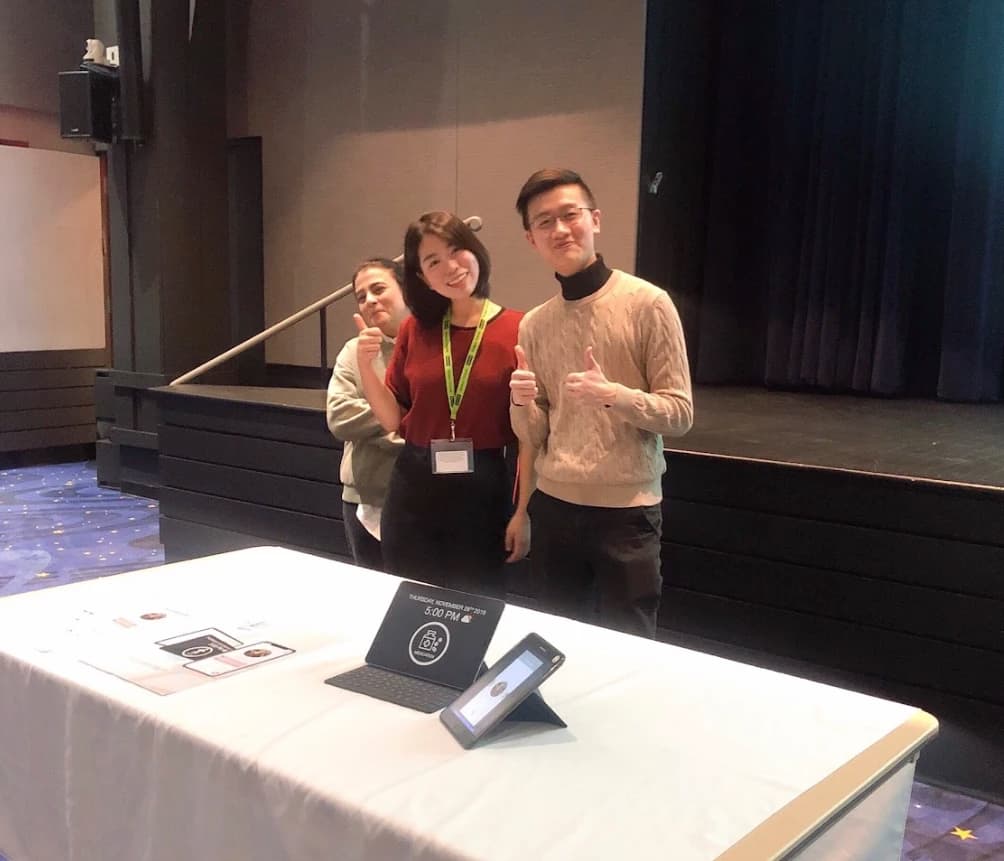
The project continued past the four-month brief. Through 2020 and 2021, the team pursued funding across front-end, back-end, and dementia-care subject matter expertise — pitching to hospitals and potential sponsors, and exhibiting at showcases across the city.
In 2021, Cue won the Design Award for Health, Wellness, Aging, and Inclusion at the Design TO Festival, and placed as a Top Finalist at the RBC Ownr Pitch Competition.
The venture pursuit eventually didn’t continue beyond the funding round, but the work itself stands as a clear demonstration of how the team approached problems too important to stop at “design comp.”
The brief
A four-month project with Baycrest Hospital to design assistive products for people living with dementia, their caregivers, and families. The work was framed not as “addressing medical deficits” but as supporting the cultural and social systems around care — a reframe that came directly from Baycrest’s own clinicians and shaped how we approached every decision.
The problem
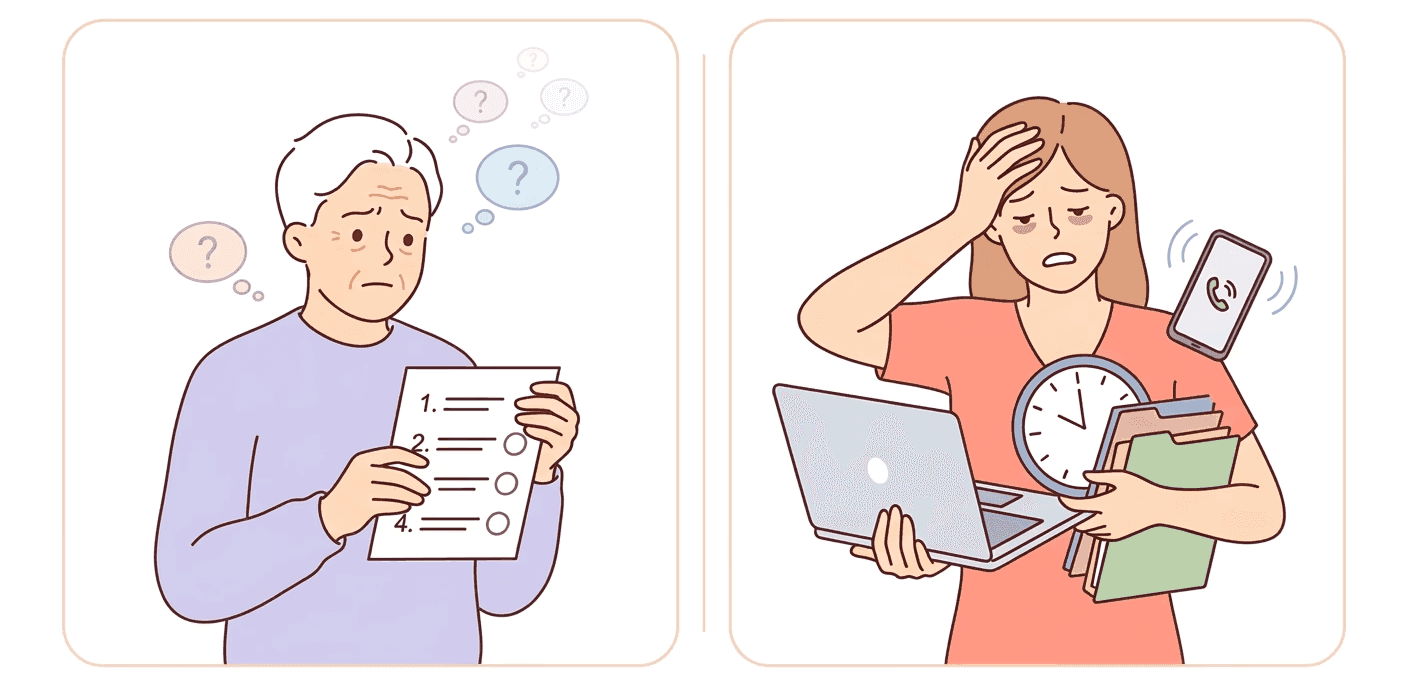
People living with early-onset Alzheimer’s struggle with multi-step instructions, frequent loss of focus, and remembering daily routines. Their caregivers face a different but related set of challenges: providing effective care while managing their own lives, with limited tools for constructive communication and shared visibility.
The gap we identified: the dementia care market splits between in-home human care services (high-quality, but variable in specialization and unaffordable for many families) and digital app-based tools (mostly focused on cognitive games or community discussion). Almost nothing bridged the two — real-time support tied to caregiver context.
That gap was where the project needed to live.
Discovery & research
We ran a multi-methodology research effort: ethnography, literature review, market analysis, and direct subject-matter feedback from more than six dementia care experts at Baycrest Hospital.
The work clarified two distinct user types with overlapping needs:
The patient — needs simple, reliable cues to support daily routines without text-heavy instructions or cognitively demanding interfaces.
The caregiver — needs visibility, async control, and a way to support a loved one without being physically present every moment.
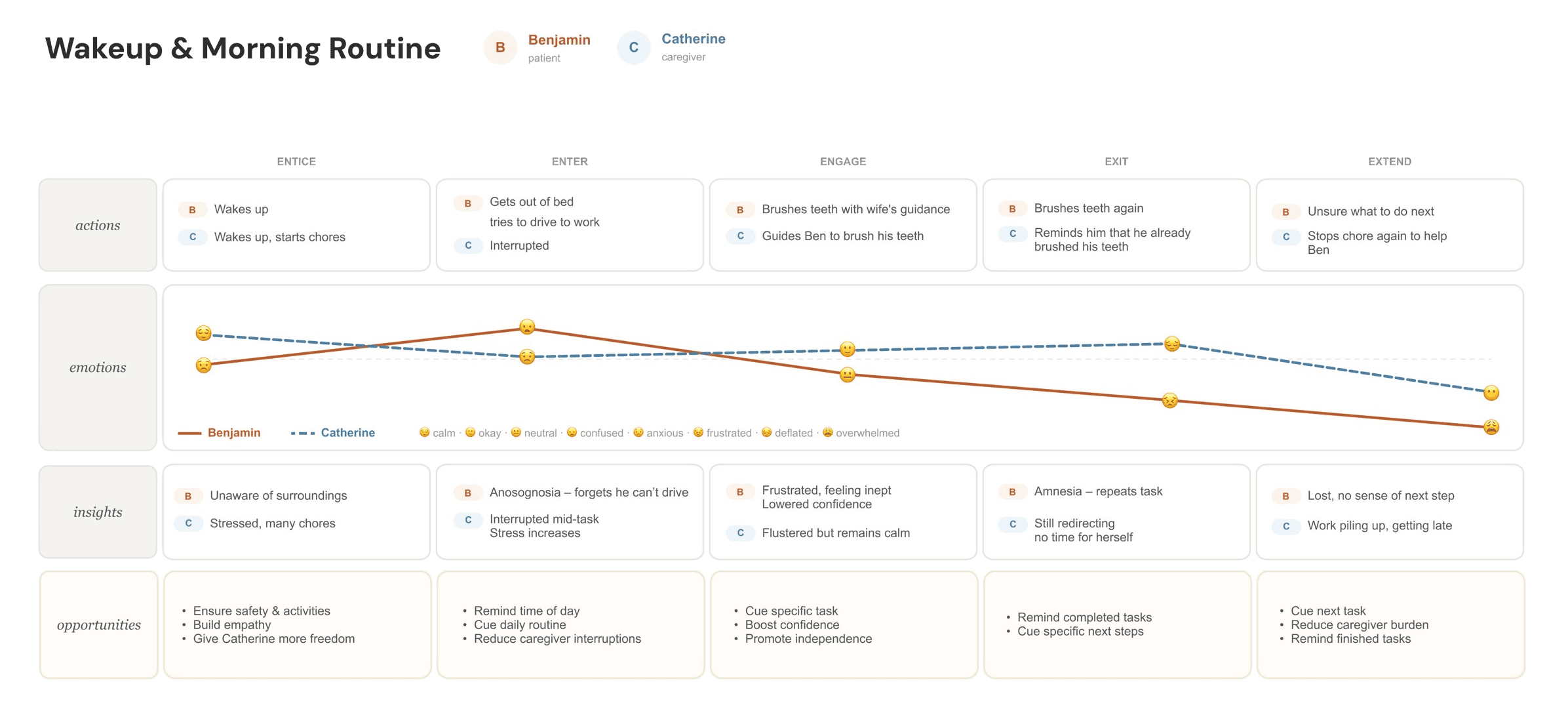
We built a journey map across both perspectives to see where their experiences connected — and that’s where the design intervention had to sit.
The pivot
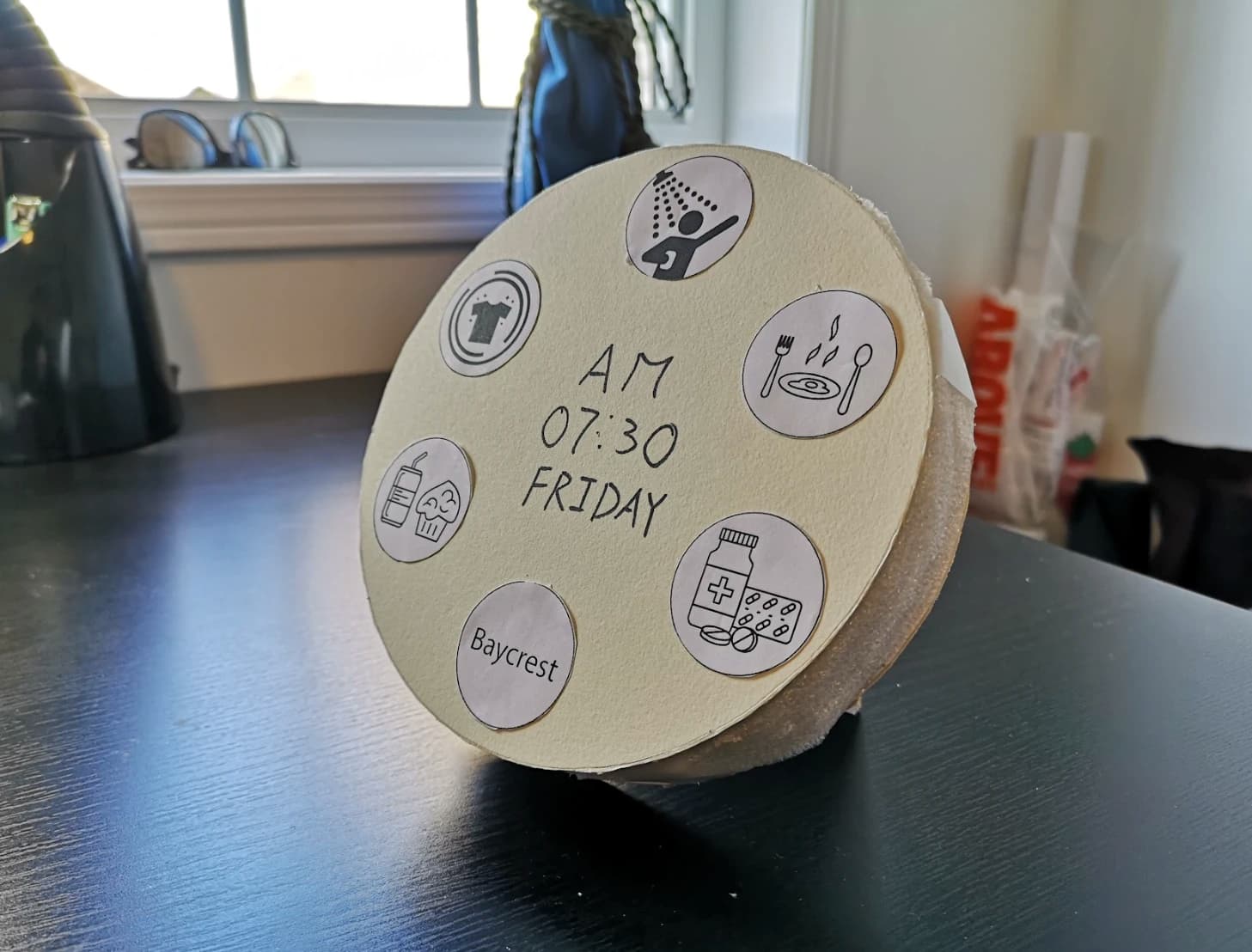
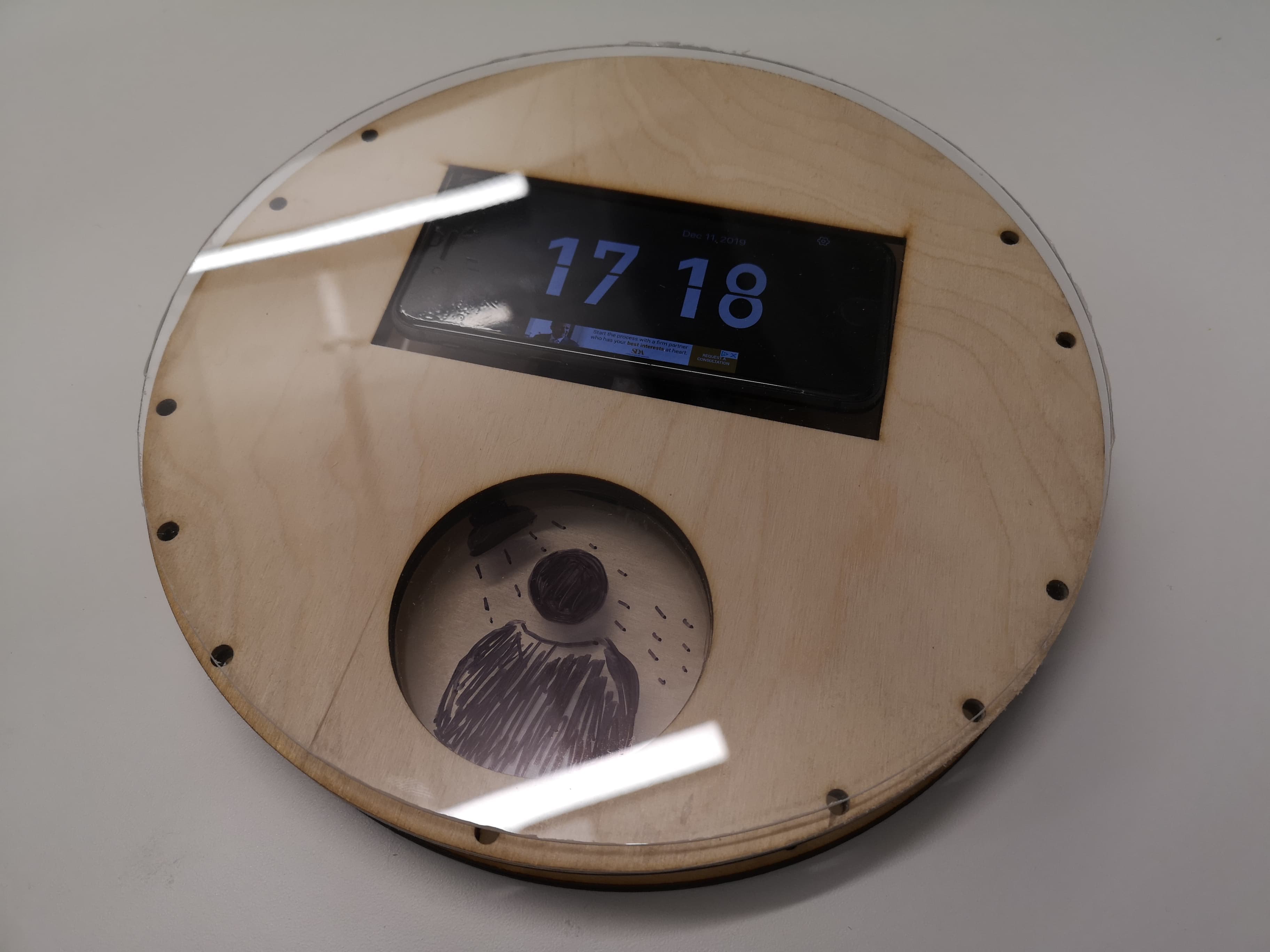
Our first prototype was a physical product — a dedicated cueing device for patients. We sketched, built, and presented to Baycrest’s care experts. The feedback was clear, and it was a pivot moment:
The market for physical assistive devices was crowded with single-purpose products that often ended up unused. The under-served opportunity was digital — specifically, a system that could connect patients and caregivers in real-time, without requiring physical presence.
We pivoted to a connected digital platform: a patient-facing app and a caregiver companion app, sharing a single source of truth. This was the design decision the rest of the project sat on top of.
What’s unique about Cue
Unlike the apps we’d surveyed in the market, Cue connects caregivers and patients in a shared, real-time experience. Family members can also access the platform to monitor their loved one’s condition throughout the day.
Three principles drove the design:
Icon-based visual cues, not text. Routines are rendered as clear, intuitive prompts — no instructions to parse, no copy that grows stale.
Remote async caregiving. Caregivers can assign and track tasks from anywhere, freeing them from the requirement of constant physical presence.
Routine as the central feature. Dementia research is unambiguous: consistent routine is one of the few interventions that meaningfully supports cognition over time. The system was designed around this finding rather than around feature parity with existing apps.
design principles for cognitive accessibility
       │
       ├──  reduce cognitive load   →  one decision per screen
       ├──  preserve dignity        →  no infantilizing language
       ├──  support caregivers      →  shared visibility, async
└── build around routine → evidence-based for cognitionWhy this still matters
Cue is older than my professional work, and I want to be honest about that. I share it because the principles that came out of this project — designed under genuine stakeholder pressure with real ethical stakes — still inform how I work today.
Designing for cognitive accessibility taught me to interrogate every interface for hidden complexity. The educational onboarding I designed at Sonnet (2024) leaned on the same instinct: that the user is paying cognitive cost for every piece of information you put in front of them, and your job is to lower that cost without lowering the substance.
Working with subject-matter experts at Baycrest taught me to design with care, not just for users. The same posture shows up in how I work cross-functionally now — assuming the people I’m collaborating with know things I don’t, and building space for that knowledge to actually shape the design.
Building for two interfaces from a single source of truth taught me what systems thinking actually feels like in practice — long before I would build anything similar professionally. I trace a direct line from this project to my recent work mapping the holistic exit journey at Sonnet (2024).
The work was student work. The lessons aren’t.