Reducing Quote Abandonment
An exit-intent system that turned permanent drop-off into recoverable opportunity
Every month, 65% of people who got an insurance quote left the site without buying — and we had no way to bring them back or understand why they left. I led the design of an exit-intent system that gave users a graceful exit and a path to return, turning a dead end into a second chance.
MVP
The shipped design
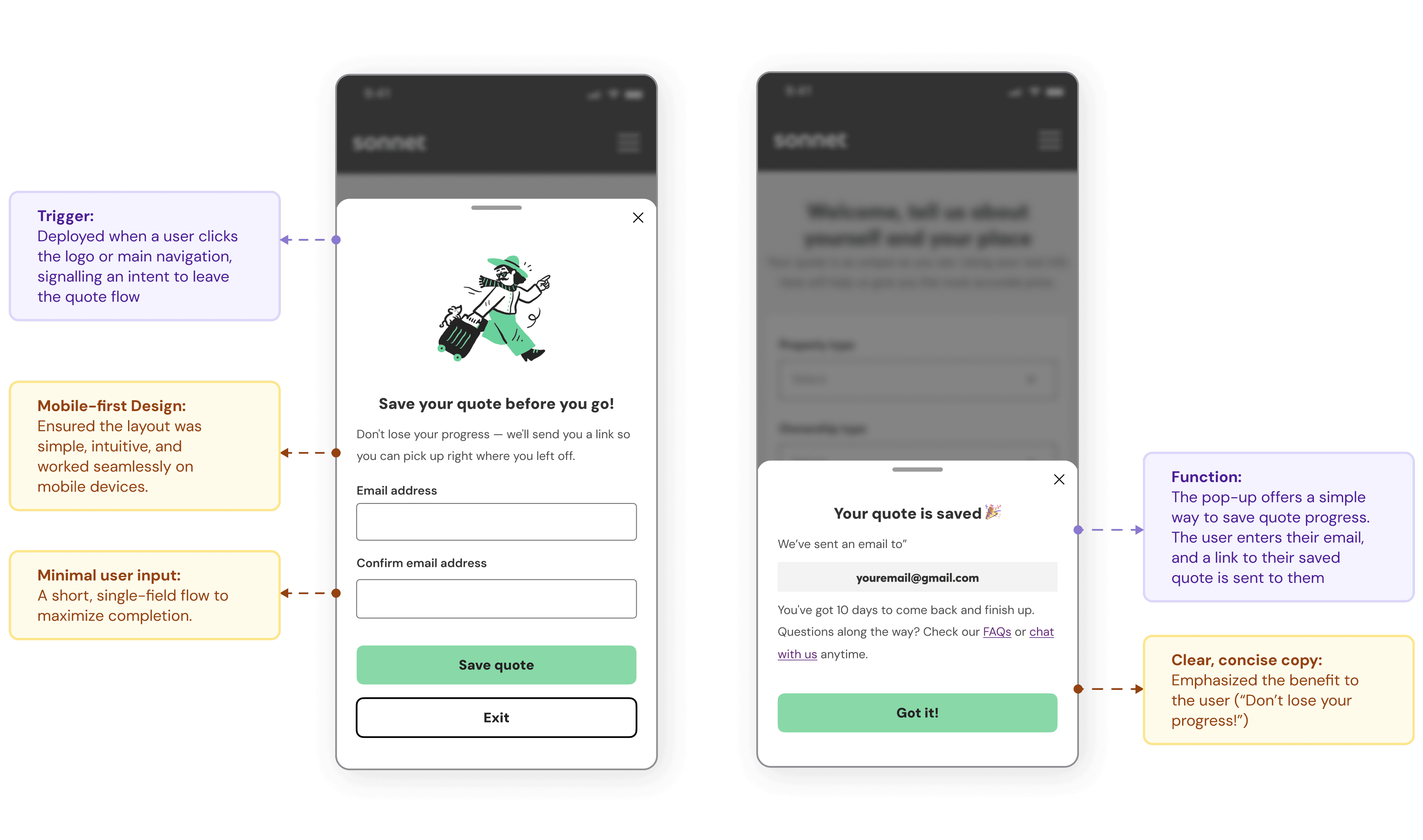
The Save & Continue Exit-Intent feature lets users save their progress mid-flow with a single tap. Accidental exits trigger a recovery prompt with the saved quote summary, eliminating the need to re-enter any information when they return.
The interaction is deliberately minimal: one prompt, one decision, no forced fields. Friction calibrated to the moment.
Impact
Saved quotes
In 6 months post-launch
+0%
Quote-to-Bind conversion
Validated post-launch
+0%
A small, well-timed prompt did more for retention than a complex multi-prompt system would have — and gave us the instrumentation to design the remaining options with real data instead of assumptions.
The challenge
An opportunity hidden in 65% drop-off
As Sonnet shifted strategy toward retention and profitability, a critical problem emerged: users were abandoning the quote flow at alarming rates, especially after seeing their price. But the deeper challenge wasn’t just the abandonment — it was that we had no way to retrieve those users, and no way to understand why they’d left.
Where it hurt
Discovery & research
Mapping every exit point
I started by mapping every possible exit across desktop and mobile — page-by-page, channel-by-channel — and partnered with the BI team to layer real funnel data over the map. The picture that emerged was consistent: most exits resulted in a complete loss of the user’s quote progress, with no instrument in place to recover or understand them.
Funnel analysis · past 30 days
Auto quote flow — where users drop off
41.6K users entered the flow · numbers consistent with trailing 12 months
Understanding the three exit behaviours
The data clustered users into three distinct exit patterns, each with a different underlying motivation:
Each pattern had different friction and required a different intervention.
Mouse drifts toward browser controls or the back button.
Clicks back to landing pages or navigates to other site areas.
Long inactivity followed by closing the tab.
Three exit behaviours · clustered from BI funnel data
The reframe
The conventional approach to abandonment is exit-intent technology that pushes users to complete now — last-chance discount, urgency banner, “are you sure?” modals. We could have done that.
Instead, I reframed the goal: convert permanent losses into recoverable opportunities. Users might not be ready now. That doesn’t mean they won’t be ready later. The system needed to give them a graceful exit and a way back, not pressure them to convert against their will.
This shift changed what we measured (saved quotes, not forced completions), what we built (a recovery mechanism, not a conversion gate), and how we framed success internally.
Intercepting users at the exit moment will recover otherwise lost quotes
Trigger a save prompt before users fully abandon
Users who save a quote are more likely to return and convert
Make resuming frictionless via email
Understanding why users leave will unlock further conversion improvements
Capture actionable feedback from abandoning users to identify friction areas
Three strategic options evaluated · we chose recovery, not conversion
user about to leave the quote flow
       │
       ├──  conventional · force completion now     →  rejected · adversarial
└── reframe · enable graceful exit + return → shipped · +10.8% savedExploration
Three solutions for three exit patterns
Drawing from the behavioural analysis, I explored three solutions tailored to each exit pattern.
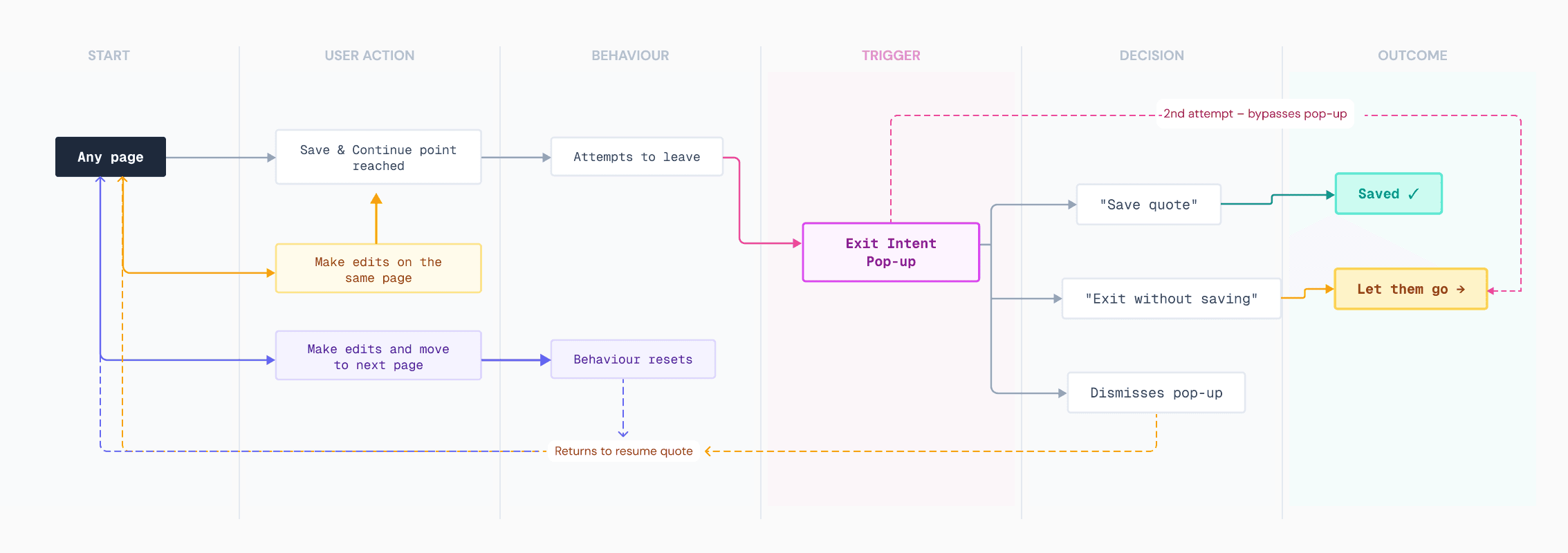
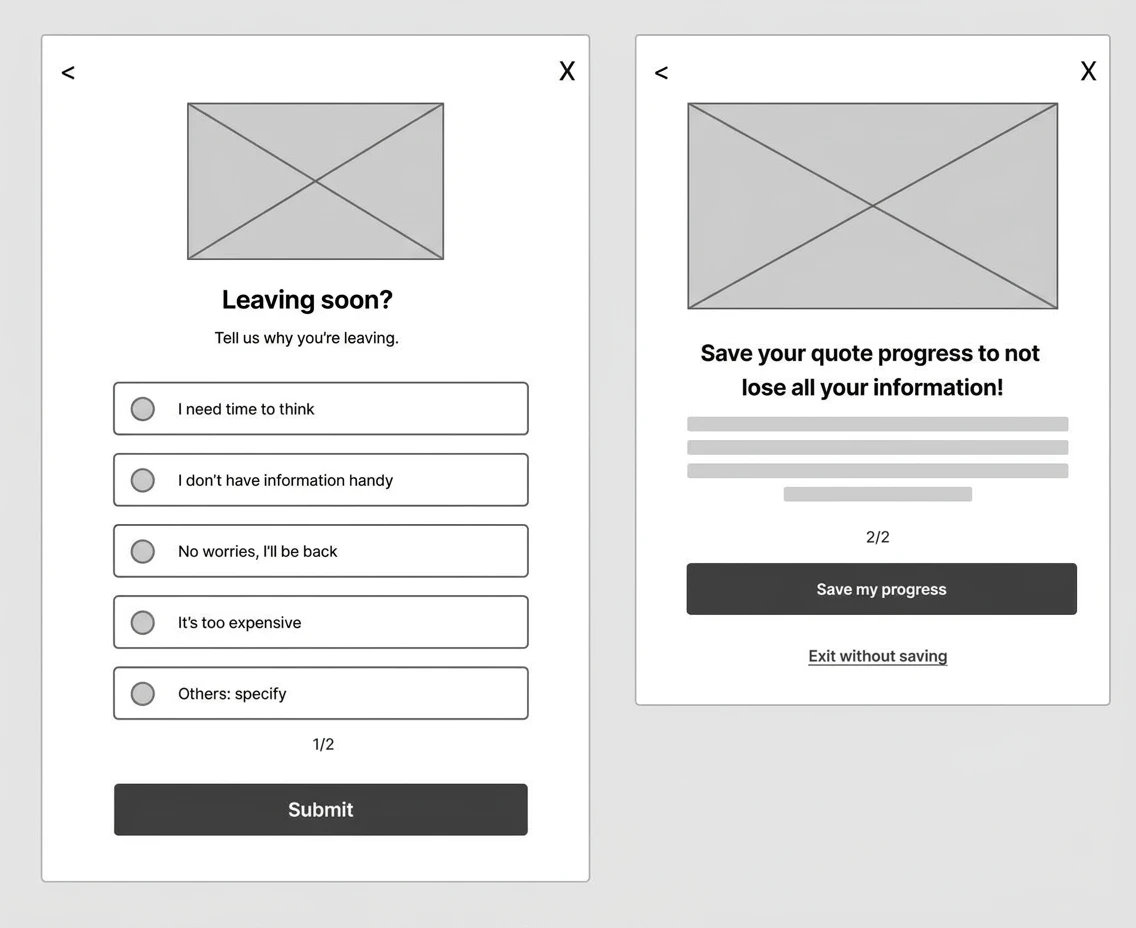
Option 1 — Survey + Save & Continue. A dual-purpose pop-up that captured abandonment reasons and allowed users to save their progress. Captured feedback for future iteration while retaining the user.
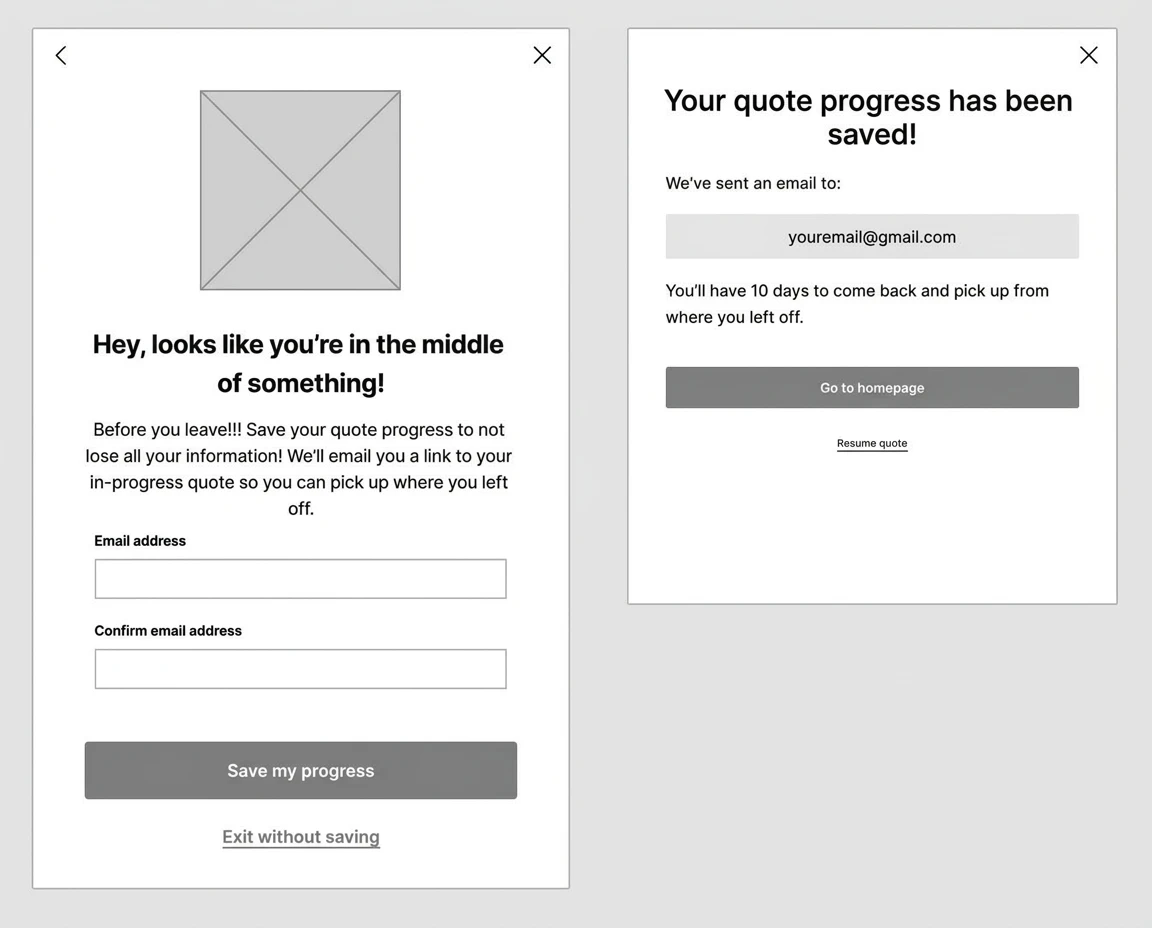
Option 2 — Save & Continue only. A focused prompt triggered when users navigated away to explore (e.g., clicking the logo). Retained users who were still interested but distracted.
Option 3 — Idle/Inactive prompt. Triggered after a period of inactivity led to a session timeout. Recovered quotes from users who had been interrupted.
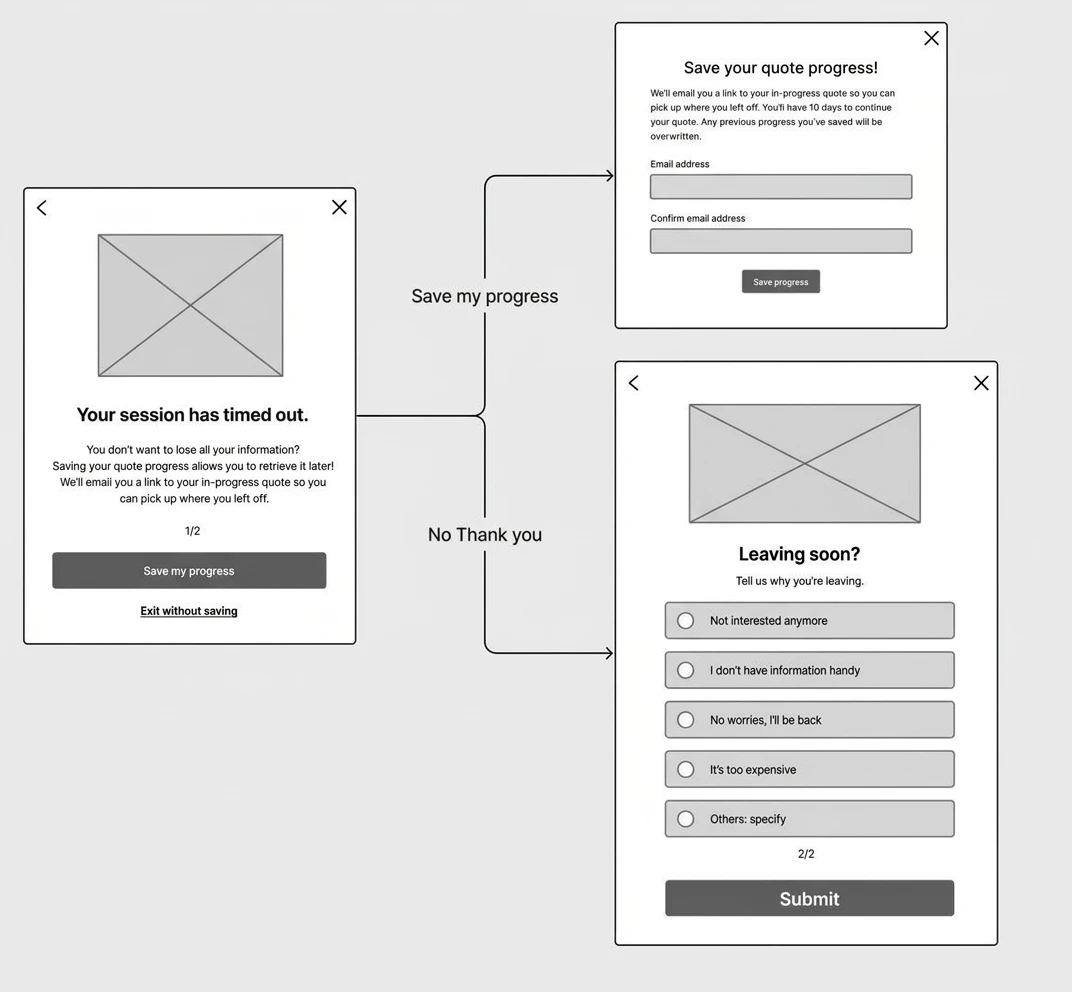
Choosing what to ship first
With limited dev bandwidth, we couldn’t ship all three for the MVP. I prioritized Option 2 — Save & Continue only because it addressed the highest-volume exit pattern (distracted users) and could be instrumented to inform Option 1 and Option 3 in subsequent releases.
The decision wasn’t a compromise. It was a sequence: ship the highest-leverage intervention first, gather real data, then iterate with confidence rather than guesswork.
What this taught me
The Save & Continue Exit-Intent feature allows users save their progress mid-flow, and accidental exits trigger a recovery prompt — eliminating the hassle of re-entering information. With this feature launch, we successfully reduced quote abandonment by enabling seamless progress preservation and recovery.
This project reinforced an important principle: not every user who leaves is lost forever. Sometimes the best design solution isn’t preventing exit — it’s making it easy to return.

Takeaways
Less is more — One well-timed trigger did more than a complex system ever could.
Friction can be intentional — Designing the exit-intent moment taught me that interrupting a user isn’t always bad — it’s about when and how you do it.
Copy is design — The success of this feature leaned heavily on clear, benefit-led microcopy. It reinforced how much words shape the user experience, not just visuals.
Challenges
Working with what you have — Limited dev bandwidth meant letting go of features I genuinely believed in. Learning to advocate, then accept, was harder than I expected.
Data only tells part of the story — We could see that users were dropping off, but understanding why some chose to restart instead of saving remained elusive. It left me wanting better feedback loops from the start.
Done is better than perfect — Shipping an incomplete solution and iterating was a mindset shift I had to embrace.